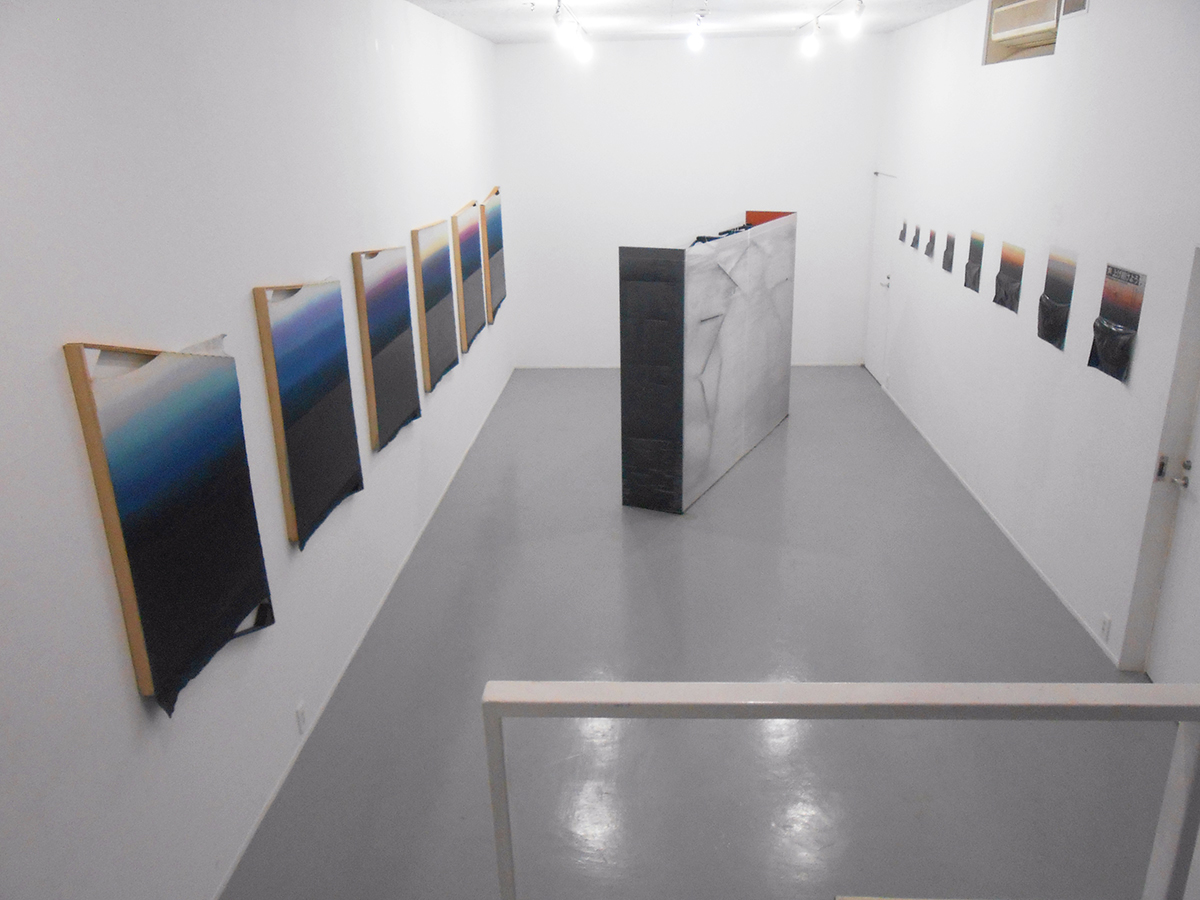
空の蒼。海の碧。毒の青。ものと絵画の狭間に入る。The blue of the sky. The blue of the sea. The blue of poison. Entering the gap between matter and painting.
もの派を咀嚼し、自分の作品の独自性を出すことを試みた。 様々な青を用い、多くの場合は、数えきれないほど塗り重ねる。 愚鈍に、ひたすら繰り返すことは、私自身の元になっていると気付いた。 作ることを通して、自分自身の気質へと遡行していった時期。
もともと、美術文脈だけに焦点を絞り、絵画性に安住することには葛藤があった。 反面、もの派的素材の扱いについても、同時代性を表し、批評的視点を持つことが可能なのか、疑問を持ち続けていた。 時代を表すテーマと存在を、同時に作品として成立させることは、常に広い視座を要求される。 これは、今でも変わらない。
Having chewed Mono-ha over, I tried to bring out what was my own in my work. I used many kinds of blue, in most cases layering them past counting. I came to see that repeating something doggedly, doltishly, was what I was made of. A period in which, through making, I traced my way back to my own temperament.
From the beginning I was uneasy about narrowing my focus to the art context alone and settling comfortably into painterliness. On the other hand, I kept doubting whether the Mono-ha handling of materials could express its own time and hold a critical point of view. To let a theme that speaks of its age and sheer existence stand together in one work always demands a wide vantage. That has not changed even now.
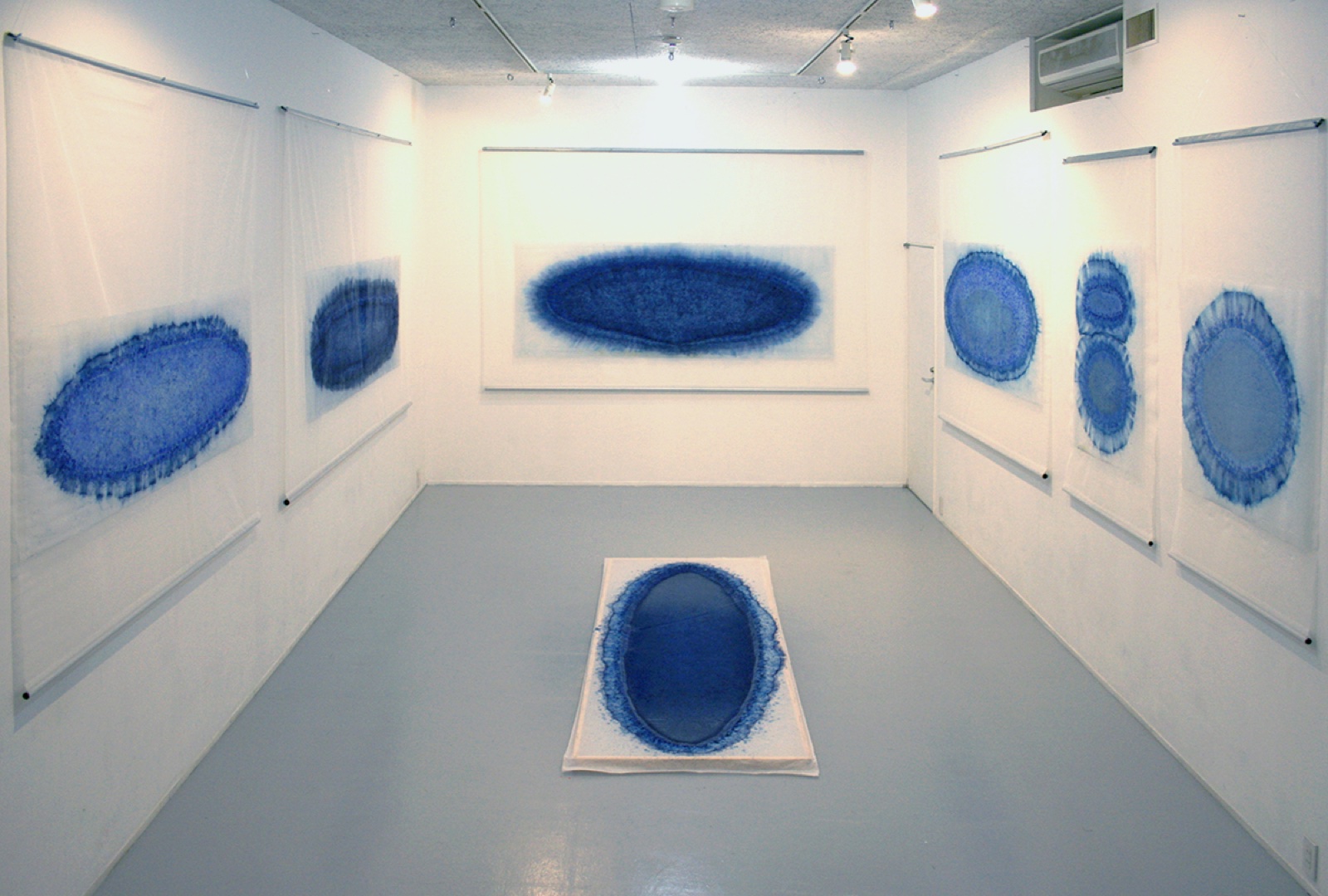
水平に溜まり、浸透し、蒸発する、水の変化そのものを定着する作品。 「浮遊体」とは、形を留めず循環する、水自体を指す。
大地に、直に粘土を張り付け、水を張り、和紙を載せて、様々な青系塗料を垂らす。 水そのものの動きが、作品中に風景を作り出していく。
A work that fixes the changing of water itself — water pooling level, seeping in, evaporating. "Floating" names the water itself, circulating without holding a form.
Clay is pressed directly onto the ground, water is drawn over it, Japanese paper is laid down, and various blue-toned paints are let fall. The movement of the water itself goes on making a landscape within the work.
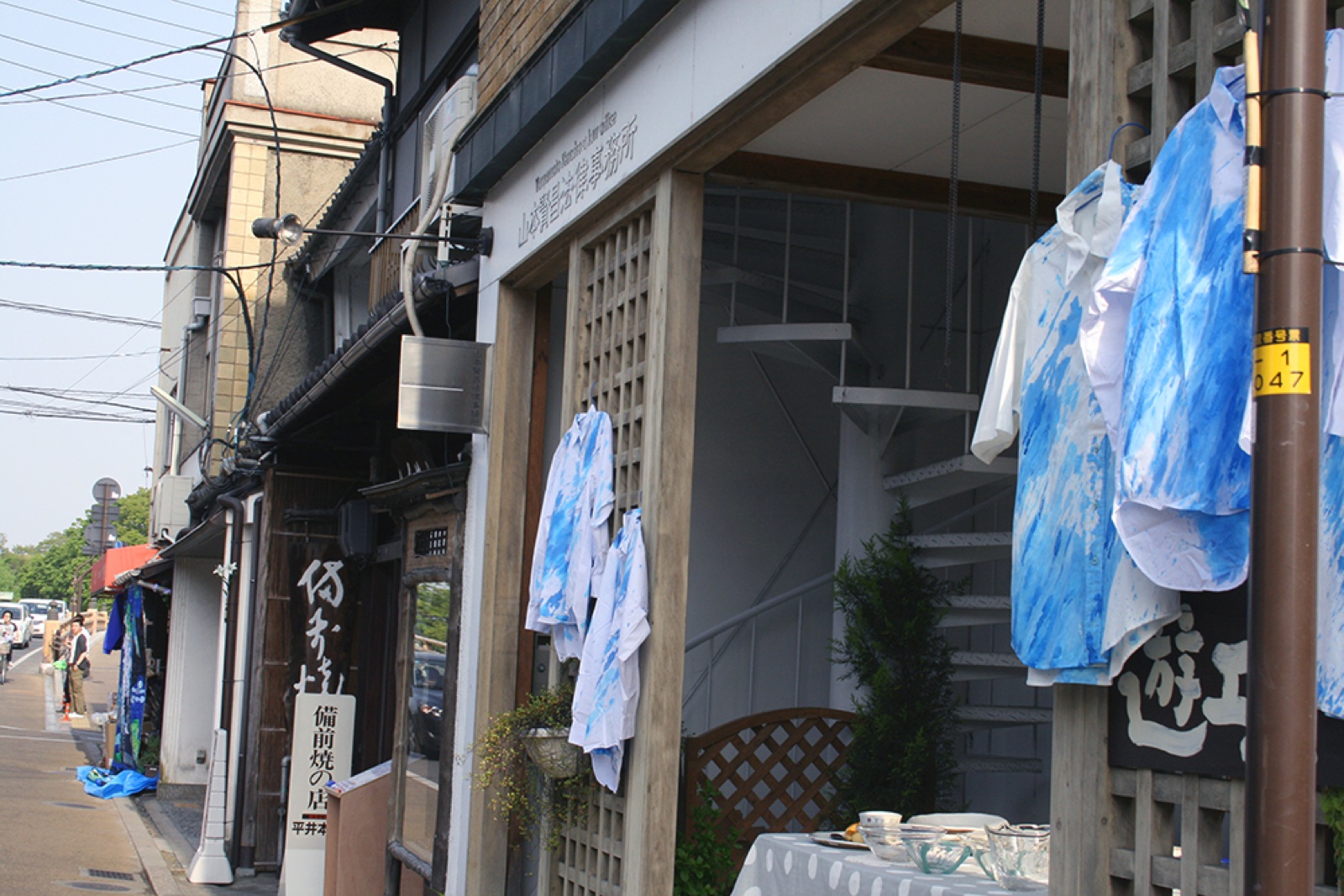
後楽園の門前町、出石町の芸術祭「出石芸術百貨街10」に出展。 出石町の方々から集めた白い古着を青く染め、街角のあちこちに展示するパフォーマンスを行った。 合計で210枚制作。 古着を集めてくださった出石町の方々、スタッフ・ボランティアの方々に感謝。
Exhibited at "Izushi Art Department Store 10," an art festival in Izushi-cho, the temple town before Korakuen Garden. I dyed white used clothes collected from residents of Izushi-cho blue, and performed by displaying them throughout the town's street corners — 210 pieces in total. My thanks to the people of Izushi-cho who collected the used clothes, and to the staff and volunteers.
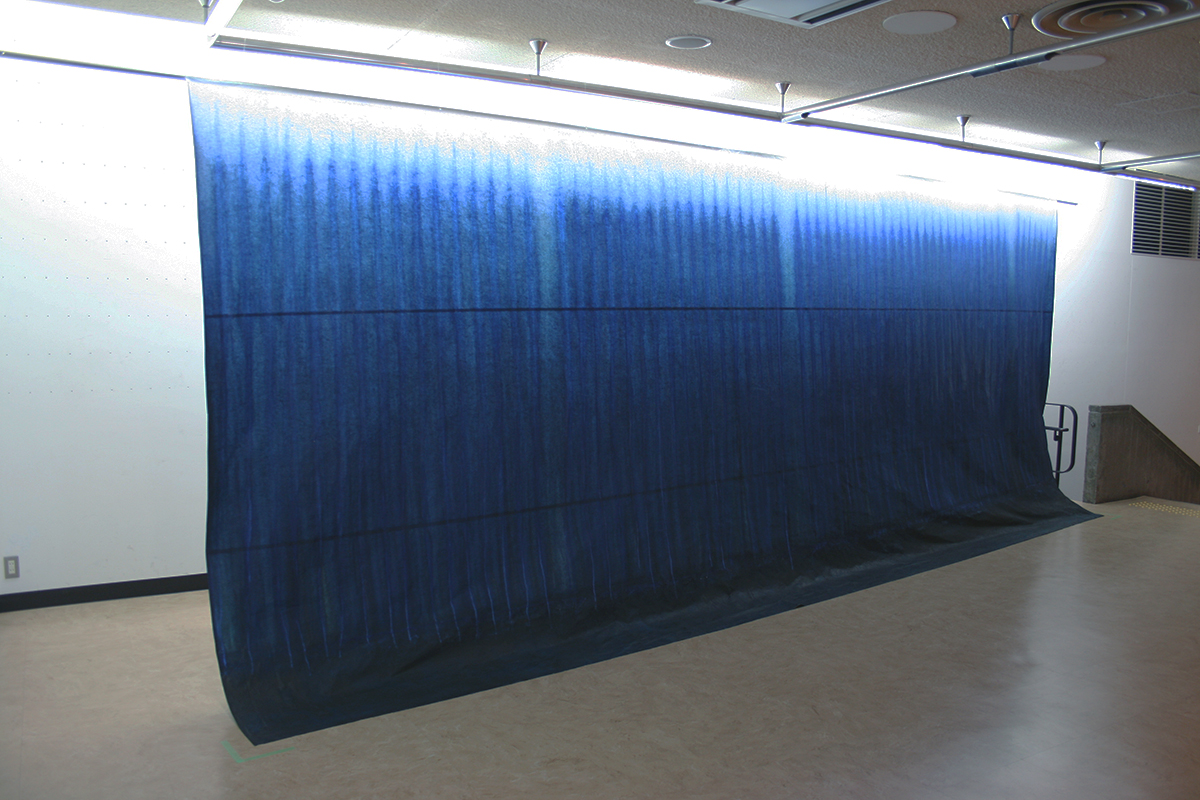
空中から吊り下げた和紙に、青い雫を垂らし滲ませていく方法を用いた。 水の重力に従う水の垂直性が、今回の重要なモチーフ。 恩師 榎倉康二ゆかりの小豆島アトリエ「梅の小屋」を改装し、そこで初めて制作した作品。
梅の小屋には「もの派」である故榎倉康二先生の文献が残っている。 学生時代から20年余り、先生を含め「もの派」の作家達と交流した記憶が生々しく思い出された。 「もの派」の身体と物質と空間との「関係」——その精神が、吊り下げた和紙に滴る青い雫の中に宿っている。
I used a method of dripping and letting blue drops bleed into Japanese paper suspended in the air. The verticality of water, following gravity, was the key motif this time. This was the first work made after renovating "Plum Hut," the Shodoshima studio associated with my teacher, the late Kōji Enokura.
Documents belonging to the late Kōji Enokura, a Mono-ha artist, remain at Plum Hut. Vivid memories resurfaced of more than twenty years of exchange, since my student days, with Mono-ha artists including my teacher. The "relationship" between body, matter, and space central to Mono-ha — that spirit resides within the blue drops dripping onto the suspended Japanese paper.
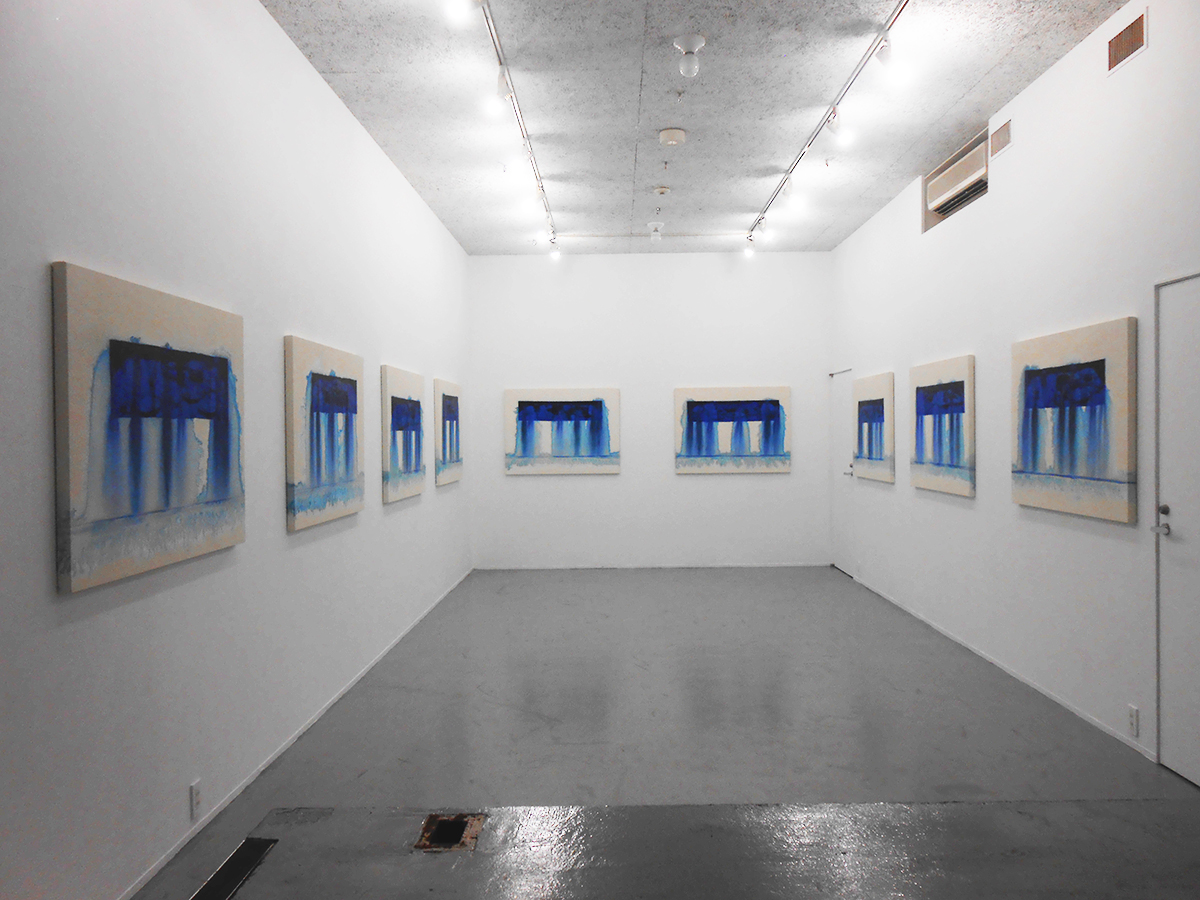
自らが描いた食卓風景、絵画の伝統-静物画としてもあるものを、自らが水滴を落として崩壊させた。 創造と破壊という相克を通して、当時の世相を描き出す試み。
「Melt through」というタイトルは、原子力発電所事故から取っている。 「食卓風景」は幸せの象徴だが、そんな大切なものさえ油断すると、あっという間に壊れかねない、そんな危うさを当時は感じた。 エゴというものは、他の視点がないと見えてこないし、何か事が起こって剥き出しになる。 日常が融解していく底知れない恐ろしさを、静寂の中に閉じ込めようとした。 描くことと、描いたものを壊していくことの対立は、方法として可能性を持つ。
A dining-table scene I had painted myself — something that also stands in the tradition of painting, as still life — I then broke down myself by letting drops of water fall on it. An attempt to draw out the mood of those years through the conflict of creation and destruction.
The title "Melt through" is taken from the nuclear power plant accident. A "dining-table scene" is a symbol of happiness, but at the time I felt how precarious it was — that even something so precious could be broken in an instant if one let one's guard down. Ego is something you cannot see without another point of view, and it is laid bare when something happens. I tried to shut the bottomless dread of the everyday melting away inside a stillness. The opposition between painting something and destroying what has been painted holds possibility as a method.
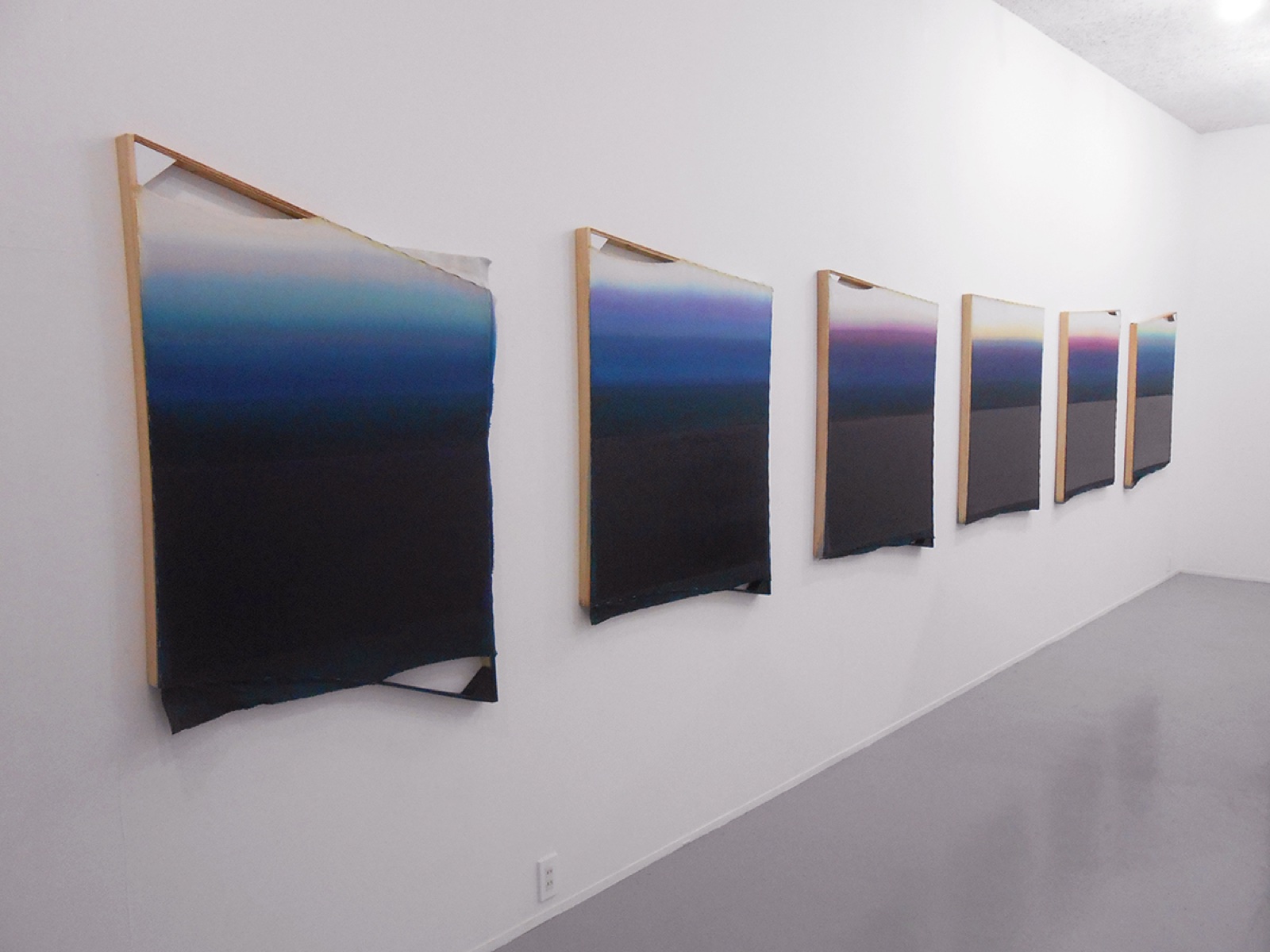
Horizon、それは地平線や水平線という、はるかな地平を指す。 皆が、同じ地平を見ているとしても、それぞれが見ている場所は違う。 この展示の場合、遥かな地平より、自分の立ち位置に重点を置いた。
いわゆる絵画を、絵画手法を用いながら解体していく試みだった。 絵画では用いられない設定や素材を用いること、具体的には、画枠が矩形ではなく歪んだ木で出来ている、壁に直接紙を張り込んで描く、机を支持体にして布を張り、画廊の表で掃き集めた泥と埃を絵の具として使う、など絵画性の解体を行った。 反面、それぞれをつなぐ共通点は、同一の高さに設定しているHorizon、水平軸だった。
もの派の関係について、両義性について、考えを進めるうちに、絵画性とは何かという問いに突き当たる。 例えば、絵画は平面として捉えられるが、支持体に厚みがある限り、歴然とした立体物である。 つまり、美術制度というものは、暗黙の了解の元、絵画が立体物であることを無視している。
ものとものを組み合わせ、ものが端的に存在を主張するためには、制度を抜きにして、木枠=木、キャンバス=布というように、物質とその成り立ちなどの関係構造を考慮しなければ、作品は成立しない。
また改めて、絵画が持つ中間領域、あいまいで淡いとも取れる領域が、豊かさを持っていることが重要である。 また、絵の具の重なりや、グラデーションから生まれる空間的視覚、象徴や比喩が引き寄せる意味の広がりは、絵画の持つ特異性である。 これらが、ものとものとをつなぐ媒介となり、作品の持つ深みとなる。 それらを抜きに、存在の奥深さを表すことが出来ないほどに。 それ故、もの派の作品は、単なる立体ではなく、構造が層として重なっているもので、絵画性の解体と再構築抜きには成立しないことに突き当たった。
Horizon — the far line where earth or sea meets sky. Even if everyone is looking at the same horizon, the place each of them looks from is different. In this exhibition I put the weight not on the far horizon but on where I stand.
It was an attempt to dismantle so-called painting while using the methods of painting. Using settings and materials that painting does not use: the frame made not of a rectangle but of warped wood; paper pasted directly onto the wall and painted on; a desk taken as the support with cloth stretched over it, and mud and dust swept up from the street in front of the gallery used as pigment — in these ways I set about dismantling painterliness. What all of them held in common, on the other hand, was the Horizon, the horizontal axis, set at one and the same height.
As I carried my thinking further about the relation of Mono-ha, about ambiguity, I ran up against the question of what painterliness is. A painting, for instance, is taken as a plane, yet so long as the support has thickness it is plainly a three-dimensional object. Which is to say that the institution of art, by tacit agreement, ignores the fact that a painting is an object in three dimensions.
For things to be combined with things, for a thing to assert its existence plainly, the work will not hold unless one sets the institution aside and takes into account the structure of relations between matter and how it came to be — wooden frame equals wood, canvas equals cloth.
And again, it matters that the middle ground painting possesses, a region that can be read as vague and faint, holds a richness of its own. The layering of paint, the spatial vision born of gradation, the widening of meaning drawn in by symbol and metaphor — these are what is singular about painting. They become the medium joining thing to thing, and the depth the work possesses. So much so that without them the profundity of existence cannot be shown. And so I came up against this: that a Mono-ha work is not simply a three-dimensional object but something whose structure is layered, and that it does not hold together without the dismantling and rebuilding of painterliness.
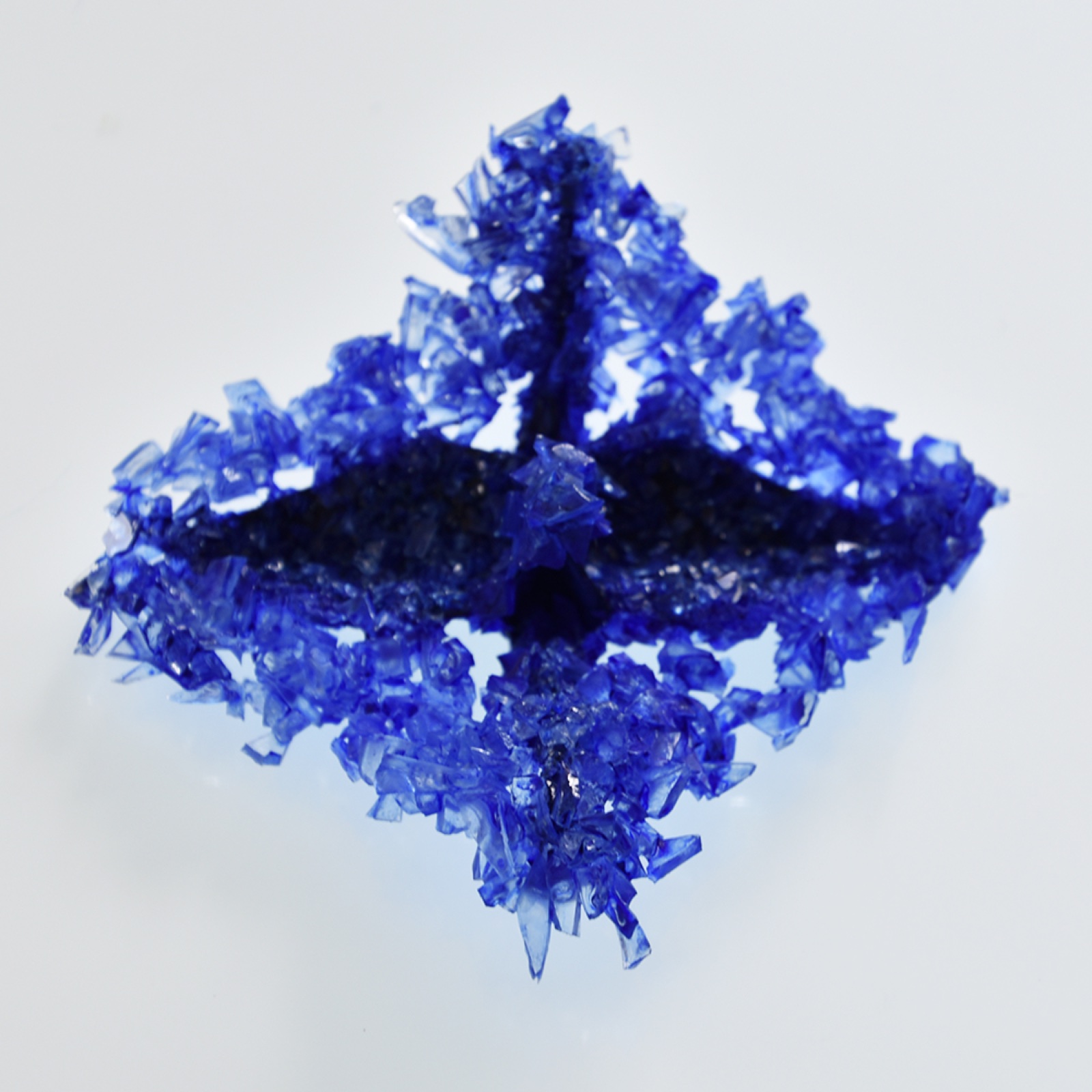
折り鶴は平和の象徴。 なぜガラスの破片を纏わせたのか?——例え平和のために声を上げるとしても、揶揄・嘲笑を受けることを覚悟しなければならない時代だから。 カゲロウの幼虫が小石をまとうように、ガラスの破片という防御を重ねた。
2020年から継続制作し、計30体以上を発表。 Space 23℃(東京)、kenakian(佐賀)ほかで展示。
The paper crane is a symbol of peace. Why did I wrap it in fragments of glass? Because we now live in an age where even raising one's voice for peace means being prepared to face ridicule and mockery. Like a mayfly larva wearing pebbles as armor, I layered on the protection of glass fragments.
Ongoing production since 2020, with more than 30 pieces presented in total. Exhibited at Space 23°C (Tokyo), kenakian (Saga), and elsewhere.
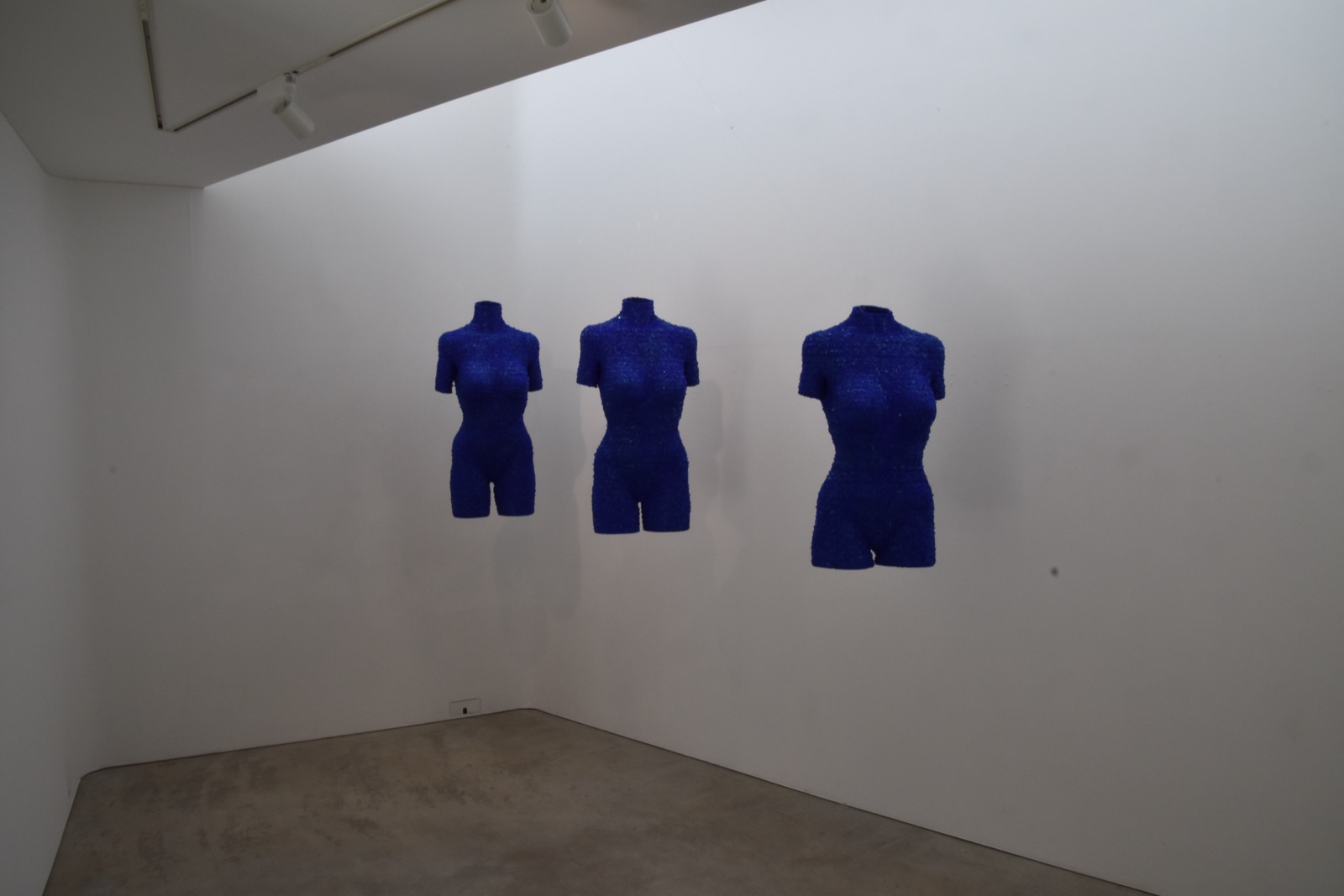
スーツには、闘う女性の身を守る鎧の意味を重ねている。
闘う女性のトルソを、3年間かけて準備。 その原型に、和紙を張り付けて乾かし、剥がして継ぎ合わせると、原型そのままの服が出来上がる。 そこにガラスの破片と青い顔料を重ね、鎧とした。 気品ある姿と強さを、併せ持つ女性の姿を形象化した。
The suit is layered with the meaning of armor that guards the body of a woman who fights.
The torso of a fighting woman was prepared over three years. Japanese paper was pasted onto that prototype, left to dry, then peeled away and joined together, and out of it came a garment exactly as the prototype had been. Onto that I layered fragments of glass and blue pigment, making it armor. It gives form to a woman who holds both dignity of bearing and strength.
折り鶴という平和の象徴にガラスの破片をまとわせ、平和のために闘うことを防御する意味を重ねた。
グラウカスとは、ウミウシの種類で、強力な毒をもつカツオノエボシというクラゲを捕食し、その毒を体内に溜めることで自分の捕食者に対抗する。
グラウカス・シリーズでは、ガラスの破片を装着し、青く染めた作品シリーズ。 小さな生物が毒や砂によって身を守るように、個人の尊厳や平和を守り、守るために抵抗する意味を重ねている。
闘う女性のためにという副題は、女性性による強さに、自分以外に大切なものを持っていて、それを守るためにレジスタンスする、利己を離れた闘いに、人間性の中心を見たことによる。 これは、女性個人やジェンダー、男性除外という狭義の意味ではない。
今でも、民主的とは言えない、否定し排除する人間性は確かに存在する。 女性が子どもを守り育てていくような、女性性の視点は、男系社会構造の持つ利己や保身のための闘いを、不要なものとして喝破する可能性を持つ。
しかし、闘う女性を取り巻く状況は厳しい。 疎外、差別、揶揄、嘲笑、同調圧力は、現実にある。 更に、権威主義の方向は強まり、利己主義は、他のための闘いを阻害する。 女性性の維持には、防御も、再意識化も必要だろう。 その意味を象徴化したシリーズ。
I attached shards of glass to the paper crane—a symbol of peace—thereby layering on the meaning of defending the fight for peace.
“Glaucus” is a kind of sea slug. It preys on the Portuguese Man O’ War, a jellyfish with a powerful poison, and by storing that poison in its own body it stands against its own predators.
The Glaucus series is a group of works fitted with fragments of glass and dyed blue. Just as small creatures protect themselves with poison or with grains of sand, the works carry the meaning of guarding the dignity of the individual and of peace, and of resisting in order to guard them.
The subtitle “for women of fighting against” comes from having seen the center of our humanity in a strength that belongs to the feminine — in holding something precious other than oneself, in resisting in order to protect it, in a fight set apart from self-interest. This is not meant in the narrow sense of individual women, of gender, or of the exclusion of men.
Even now there certainly exists a way of being human that is far from democratic, that denies and excludes. A feminine point of view — the way a woman protects and raises a child — holds the possibility of seeing through the fights for self-interest and self-preservation within a male-line social structure, and calling them unnecessary.
Yet the circumstances surrounding women who fight are harsh. Exclusion, discrimination, ridicule, mockery and the pressure to conform are real. Authoritarianism grows stronger still, and self-interest obstructs any fight undertaken for others. Sustaining the feminine will call for defense, and for a renewed awareness. This is a series that gives that meaning symbolic form.
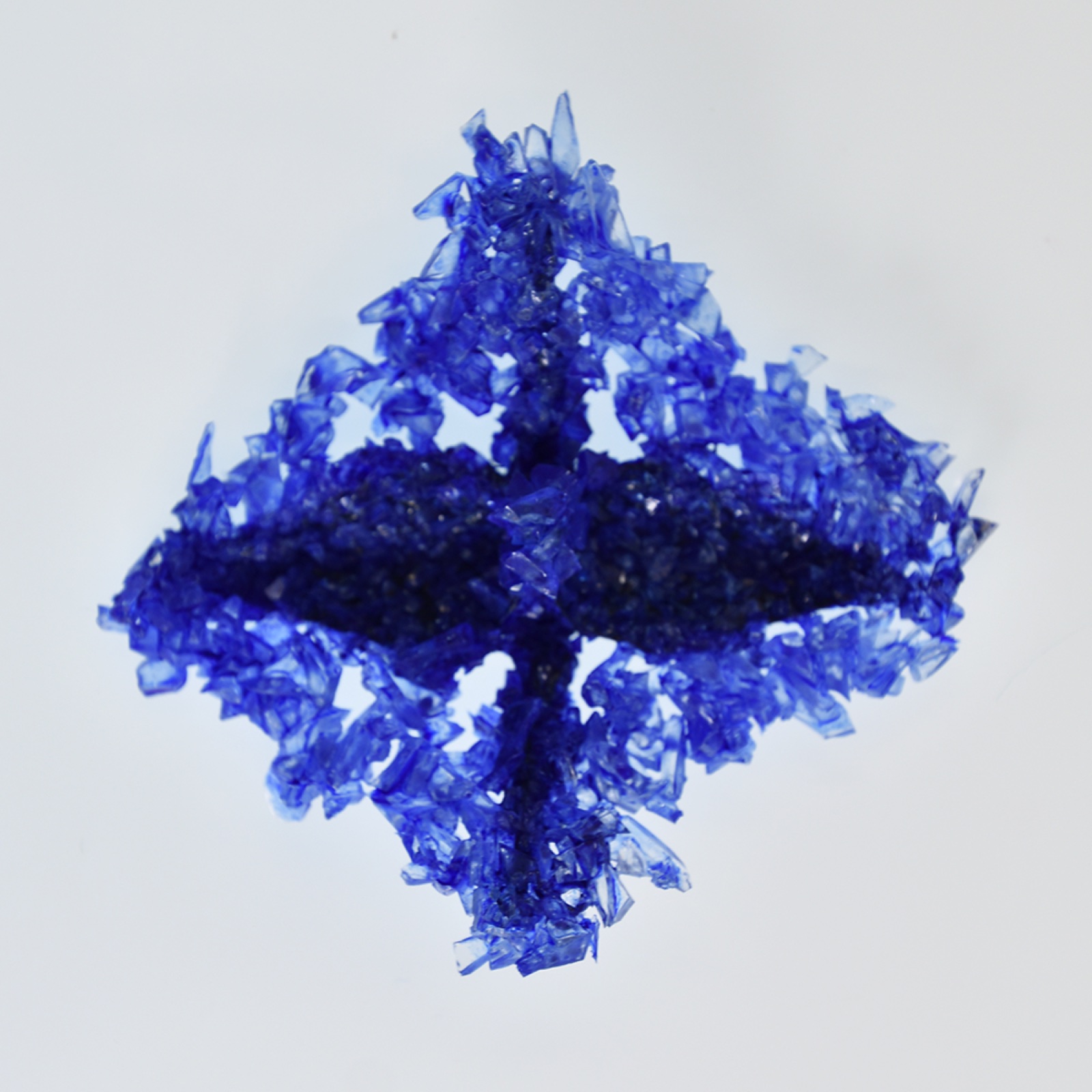
2020年12月から2021年2月まで、コンセプト付きのシリーズ作品として、Facebookで週1回発表。 差別・同調圧力・封建主義・ポピュリズムといった現代の問題を、ゆっくりと時間をかけて考え、言語化した。 SNSと英語は、規制や組織を越えて繋がっていく可能性があると考えている。
「自由は、アートにとって一番大切なこと。 差別、同調圧力、封建主義に対するには?自身に、主体を取り戻すことです。」——歳森 勲
販売しています。 お問い合わせください。
From December 2020 to February 2021, I presented this work as a conceptual series once a week on Facebook. I took time to slowly think through and put into words contemporary issues such as discrimination, peer pressure, feudalism, and populism. I believe that social media and the English language have the potential to connect across regulations and organizations.
"Freedom is the most important thing for art. How does one confront discrimination, peer pressure, feudalism? By reclaiming agency for oneself." — Isao Toshimori
Available for purchase. Please inquire.
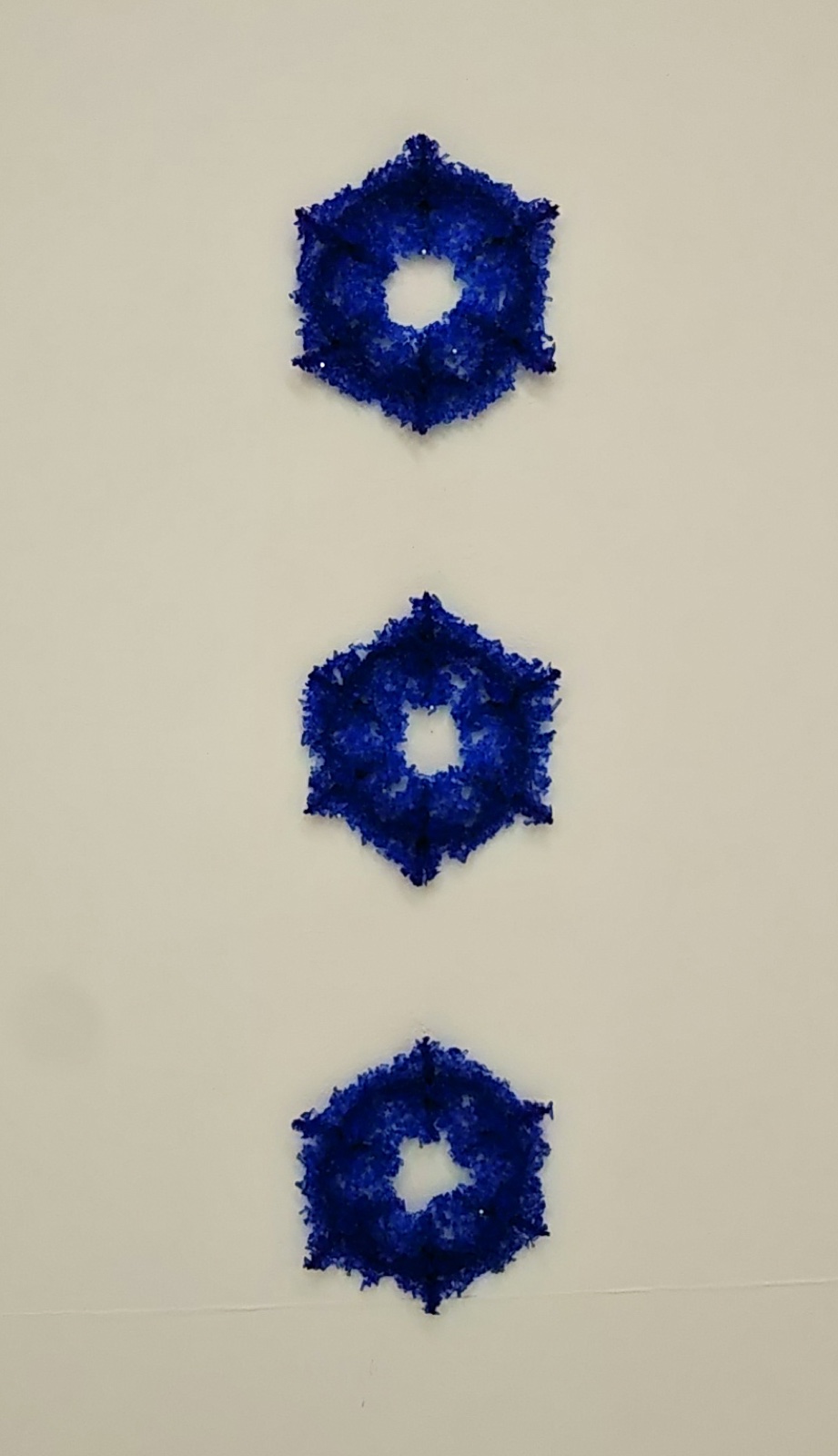
「つる」作品の6連シリーズをまとめたページ。 「Multigeneration Square 交錯する世代 対峙する絵画」展(藍画廊・GALERIE SOL 合同展)にてNo.1〜3を発表。 グラウカス・シリーズ ―闘う女性のために。
A page bringing together a series of six "Tsuru" works. No. 1–3 were presented at "Multigeneration Square: Intersecting Generations, Confronting Painting" (a joint exhibition of Ai Gallery and GALERIE SOL). Glaucus Series — for women who fight.
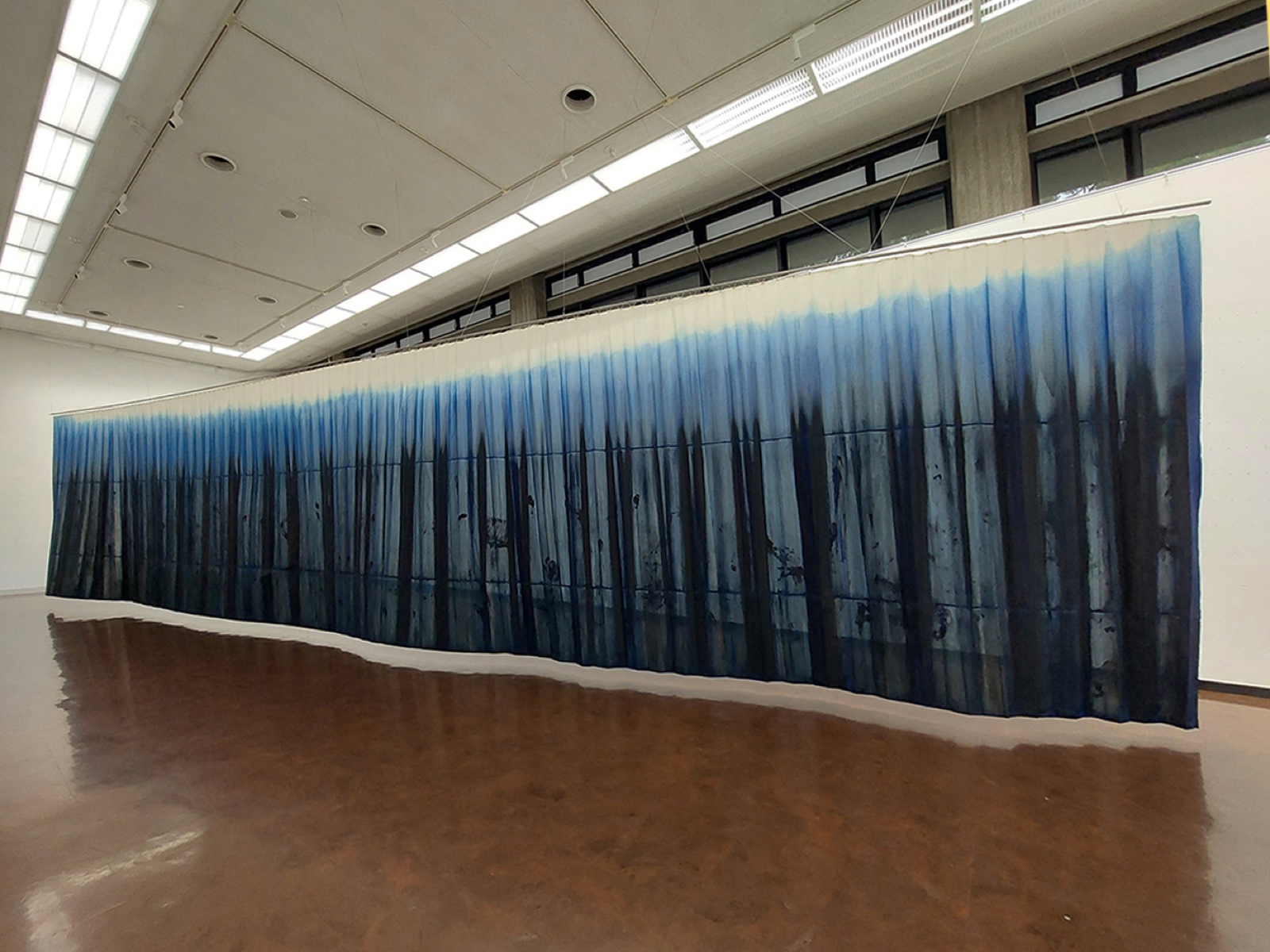
鎮魂の形象化を志向する。 子供服の痕跡をカーテンに残し、その上から青系塗料を塗り重ね、白から青へ、青から黒へというグラデーションを、祈りの行為として定着した。
文字通りカーテンレールに布地を吊り下げ、アコーデオンのように、布地を広げたり、折りたたみながら制作した。 カーテンには山と谷が出来、塗料を吹き付ける際、塗布される量が変化する。 淡い塗料の塗り重ねによって生まれる微妙なグラデーションは、そのような自然の作用の助けも借りて、微細に変化しながら傷が癒えていくような優しい表情を作った。
Aiming at giving form to a requiem. Traces of children's clothing were left on the curtain, blue-toned paint was layered over them, and a gradation from white to blue, from blue to black, was fixed there as an act of prayer.
The cloth was hung from a curtain rail, literally, and the work was made while spreading it out and folding it up like an accordion. Ridges and troughs form in the curtain, so that when paint is sprayed the amount that settles varies. The delicate gradation born of layering thin paint, helped along by that working of nature, made a gentle expression that shifts by minute degrees, like a wound healing over.
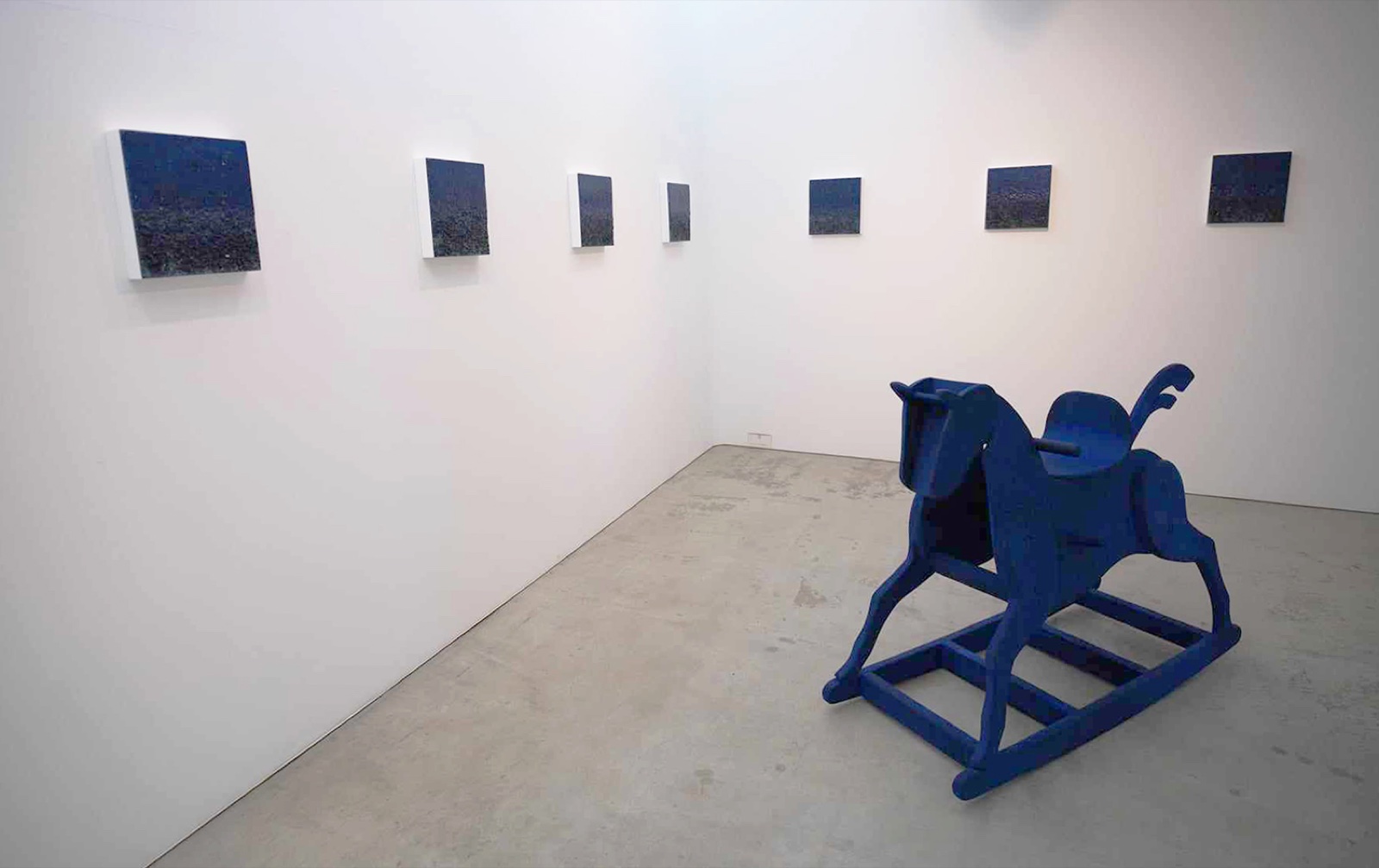
ガラス片を、青と共に塗り重ね、固めては研ぎ出すことを、数十回繰り返す。 固めては削り出す、自己と物質のせめぎあいが主となって、合理性を超えていく。 複雑な層から、想像を超える青味や奥行きが生まれた。 コロナ禍で意識せざるを得なかった、生と死の循環、元に還る意味などの深淵が、作品と同期している。
木馬に乗って揺れ動くことは、生成と還元、生と死と重なり、鑑賞者と木馬の間に物語が生まれる。 ものと身体との関係が、今、ここに織り重なっていく。
自己と物質のせめぎあいは、均衡点、境界といったものを強く意識させる。 もう一回削ると、ぼろぼろに崩れ去ってしまうような、指先のひりつく感覚が、生成と還元の動的均衡。 それは、今、現実に、目の前で起こっていることであり、「今」「ここ」に、私とものが「しかと」存在している感覚を生む。
Fragments of glass are layered together with blue, hardened and then ground back, dozens of times over. Hardening, then cutting away — the contention between self and matter takes the lead, and goes beyond what reason can account for. Out of the complex layers came a blueness and a depth past imagining. The abyss I could not help being conscious of during the pandemic — the circulation of life and death, the meaning of returning to what one was — is in step with the work.
Rocking on the wooden horse overlaps with generation and reduction, with life and death, and a story arises between the viewer and the horse. The relation between thing and body is woven together here and now.
The contention between self and matter makes one keenly conscious of a balancing point, of a boundary. That prickling in the fingertips — that one more pass of the blade would crumble it away — is the dynamic equilibrium of generation and reduction. It is something happening right now, in reality, before one's eyes, and it gives rise to the sense that "now," "here," I and the thing are unmistakably present.
世界と共にTogether with the world