伝統と聖性が織り成す、新しさを見る。Seeing what is new in the weave of tradition and the sacred.
ものに向き合ううちに、その更に先にある、良質な存在を問うことは自然な展開だった。
幼少のころから、四国八十八か所を連れられて歩いた私は、宗教性に対する抵抗は無かった。 そして日本だけではなく興味は西洋に向かった。
ドクメンタ9は、現代美術がいかに自由で様々な表現が可能であり、社会と結びついているものであるか見せ付けられた。
そして一人、マウント・アトスを目指した。 ギリシャ領事館の入山許可証がなかなか降りず、ギリシャ国内を行ったり来たりしたが、アトス山に点在する修道院を訪ね歩き、ミサに同列させてもらった。 深夜から始まる瞑想的祈りは、深い内観の世界を感じさせる稀有なものだった。 それに触れることが出来たことは、深く記憶に刻まれている。
クレタ島中央の、イデオン・アンドロンでは一夜を過ごした。 目の前に広がった巨大なクレーターが、月に照らされていた。 確かにそれは宇宙の一部だった。
日本に帰って、岡山曹源寺で大接心に参加する希望を出して、ご方丈の許可を得た。 自己の内面には、はるかな広がり持つ世界があった。
これらは全部、自分の体を使った思い出だが、今でも自分の内部に蓄積されていることを感じる。 観念ではなく、体で解ることが必要だから。
As I went on facing things, it was a natural development to ask after the finer existence lying further beyond them.
Having been led on foot around the eighty-eight temples of Shikoku since early childhood, I felt no resistance to religiosity. And my interest turned not only to Japan but to the West.
documenta 9 showed me plainly how free contemporary art is, how many kinds of expression are possible in it, and how bound up it is with society.
Then I set out alone for Mount Athos. The entry permit from the Greek consulate was slow in coming and I went back and forth inside Greece, but I walked from monastery to monastery among those scattered over Mount Athos, and was allowed to join the services. The meditative prayer that begins in the dead of night was a rare thing, giving a sense of a deep inner world. Being able to touch it is carved deeply into my memory.
In the Ideon Andron, in the centre of Crete, I spent a night. A vast crater spread out before me, lit by the moon. It was, without doubt, a part of the universe.
Back in Japan I asked to take part in a great sesshin at Sogen-ji in Okayama, and received the abbot’s permission. Within my own interior there was a world of far-reaching expanse.
All of these are memories made with my own body, and even now I feel them accumulated inside me. Because what is needed is to understand with the body, not with concepts.
聖なるものへの希求が、日本の庭との出会いとなったのは、自然だった。
当時仕事をいただいていた、伝統作庭家 金綱重治氏との出会いは大きかった。
That my longing for the sacred should lead me to an encounter with the Japanese garden was only natural.
My meeting with Shigeharu Kanetsuna, a gardener working in the traditional manner for whom I was doing work at the time, meant a great deal to me.
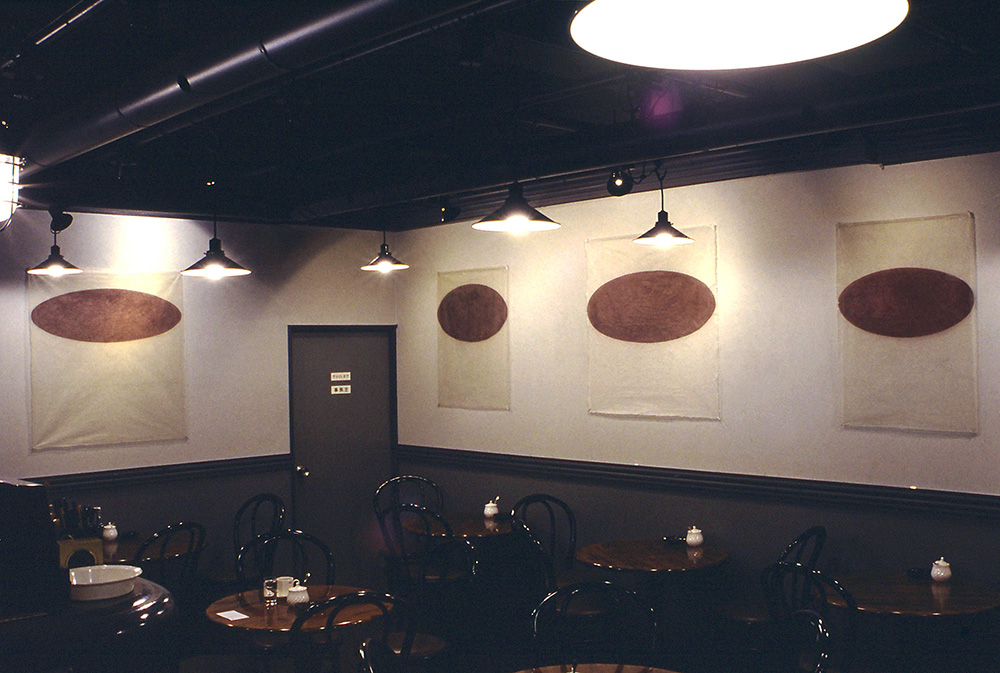
和紙にボールペンで、ドーム形のドローイングを描き始めたのもその頃である。 ヨーロッパの記憶を基にして、象徴的に浮かんできた形態は、天蓋であるドーム形だった。
何時でも、どこでも、臨機応変に対応できる展示方法としてもあった。 軽く薄いドローイングを壁に貼るだけで、違う世界への窓として機能するからである。
象徴というものは、実に重要である。 目の前にある岩が、そのまま岩であることなく、枯山水では宇宙の表現となる。 広く大きな世界は、象徴によって意味を代弁する以外に方法がない。
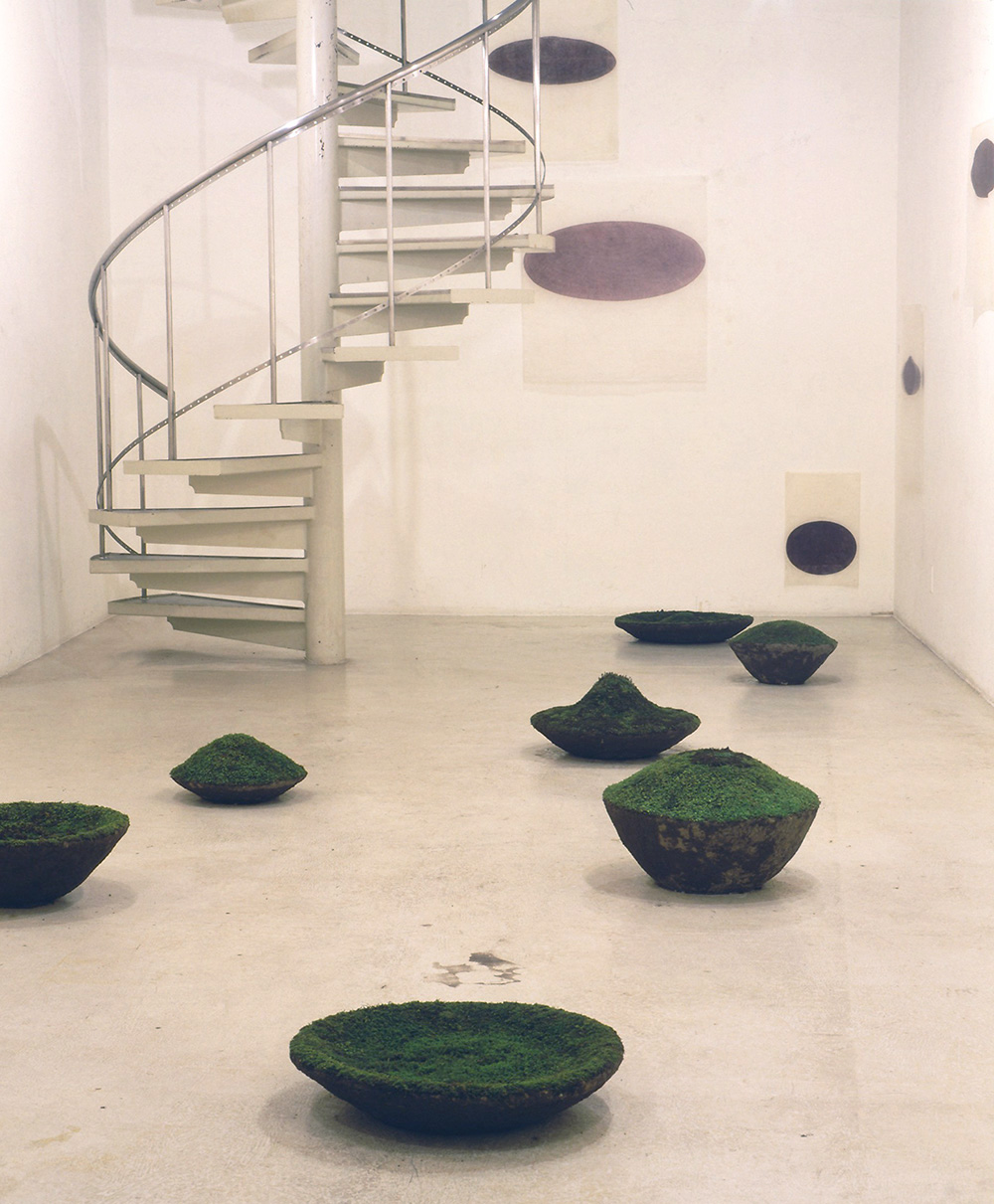
また、苔を張り付けた円形のオブジェクトを作ったのもこの頃である。 だが、生き物を扱うのは、技術と設備が必要だった。 芸大の中庭に許可を取って庭を設置したが、それは奇跡的に今も残っている。
It was around then that I began drawing dome shapes in ballpoint pen on Japanese paper. Drawing on my memories of Europe, the form that rose up symbolically was the dome — a canopy.
It was also a way of showing work that could adapt to any time and any place, since a light, thin drawing needs only to be pasted on a wall to function as a window onto a different world.
The symbol is truly important. A rock in front of you is not simply a rock: in a dry landscape garden it becomes an expression of the universe. For a world this wide and this large, there is no way to speak its meaning other than through symbols.
It was also around this time that I made a circular object with moss fixed to it. But handling living things called for technique and for equipment. I obtained permission and set a garden in the courtyard of the university of the arts, and miraculously it is still there today.
しかしアートと伝統との違いは明らかだった。
アートとなるためには、現代性を内包する必要があった。
現代性を内包するには、批評性を含んだカウンターの意味が必要に思えた。
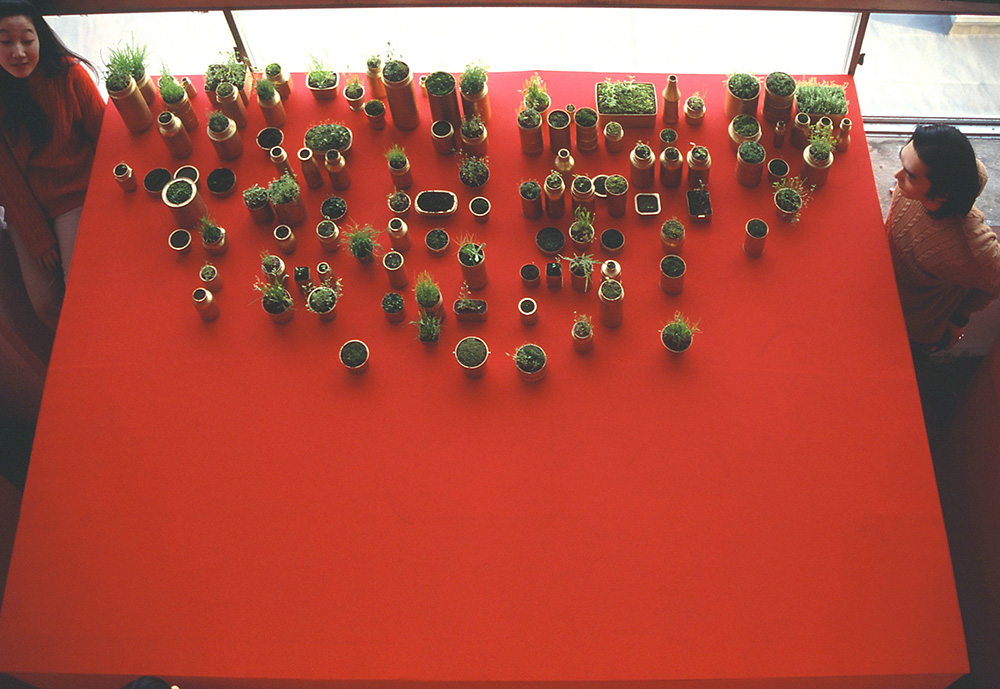
「告発する庭―クリティカル・ランドスケープ」をコンセプトの核として、現代を借景として取り込み、現代美術としての庭を実現することを志向した。 そのため、伝統的庭には含まれない素材、日用品であるガラス器、雑草、赤い布を用いて、伝統から逸脱した。
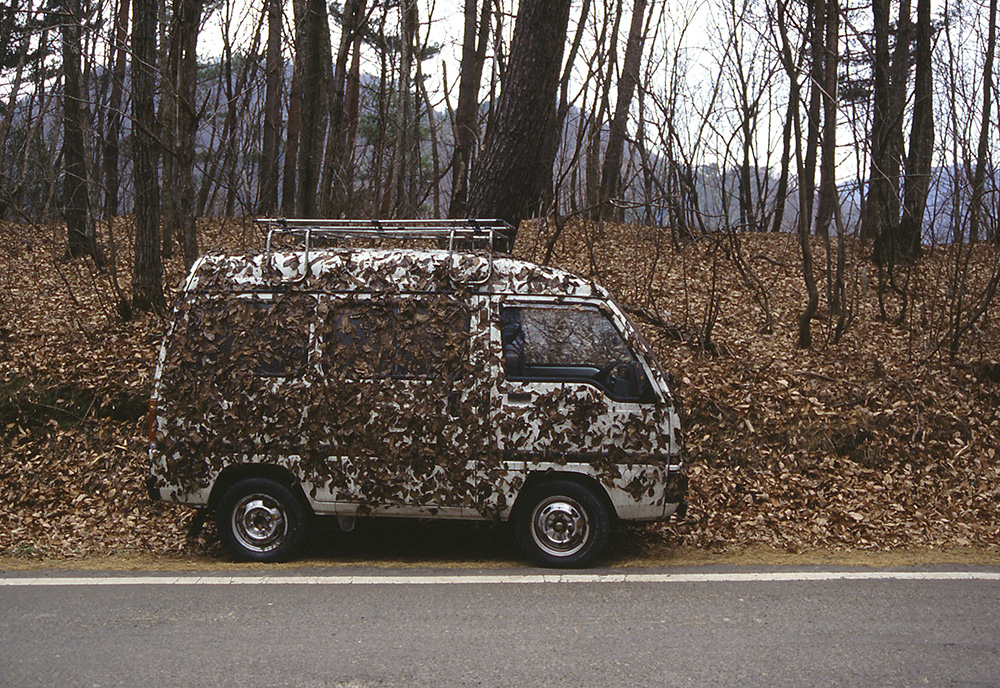
車に落ち葉を塗り付けるパフォーマンスも、「告発する庭」から発想された。
「告発する庭」という方法論は、アンビバレンツという方法論に自然につながっていった。
But the difference between art and tradition was clear.
To become art, a work had to hold contemporaneity within it.
And to hold contemporaneity, it seemed to me, it needed the sense of a counter — one carrying a critical edge.
With “The Accusing Garden — Critical Landscape” as the core of the concept, I took the present day in as borrowed scenery and set out to realise a garden as contemporary art. To that end I used materials a traditional garden does not contain — everyday glassware, weeds, red cloth — and departed from tradition.
The performance of smearing fallen leaves onto a car also grew out of “The Accusing Garden”.
The methodology of “The Accusing Garden” led naturally into the methodology of ambivalence.
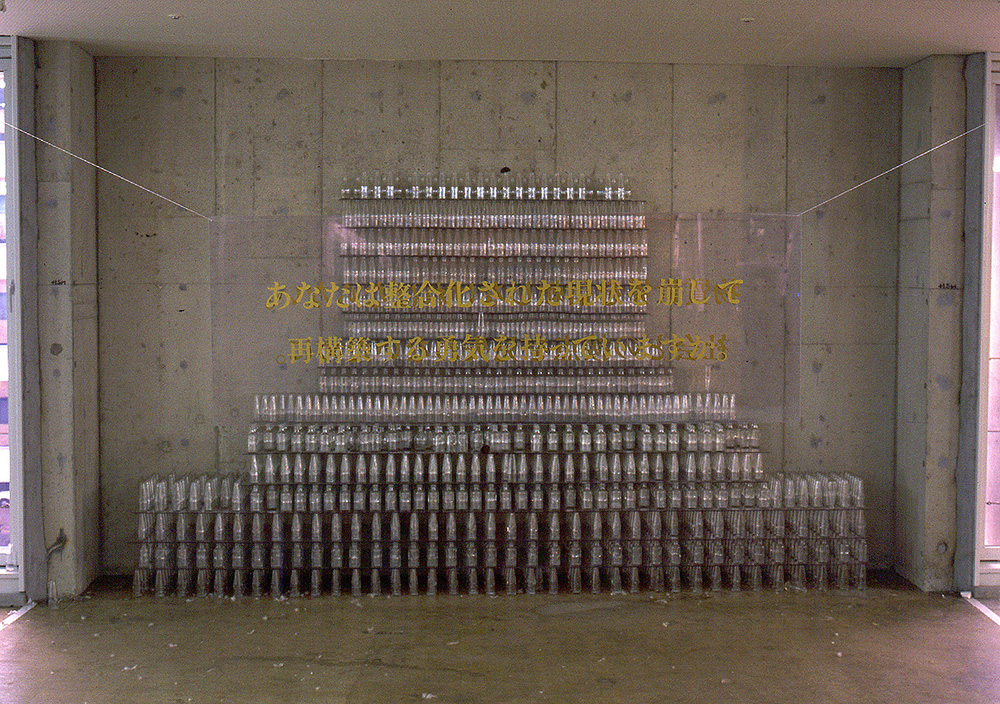
建築科研究室と油画科研究室が共同で行った「環境と行為」というグループ展が行われた。 透明なアクリル板に両側から相反するメッセージがプリントされているが、重なっているため、良く読めない。 メッセージに対して賛同する場合は、展示された人工物=ビンと自然物=石を、観客は動かすことが出来る。 石あるいはビンが動かされるうちに、ビンが積み上がった「城」は崩れたが、石が塞いでいた「扉」は開かれるまでには至らなかった。
透明なアクリル板にプリントされたメッセージは、それぞれを読むと素直に読めるが、表裏で反語として対立している。 人間の持つ明らかな矛盾なのか、アンビバレントな真実なのか、今でも的を得ているようで、興味深い言葉の作品となっている。
A group exhibition called "Environment and Action," held jointly by the architecture research lab and the oil painting research lab. Contradictory messages were printed on either side of a transparent acrylic panel, but because they overlapped, neither could be read clearly. Visitors who agreed with a message were free to move the manufactured objects — bottles — and the natural objects — stones — on display. As the stones and bottles were moved, the "castle" piled up out of bottles crumbled, but the "door" the stones had blocked never quite came to be opened.
Read one at a time, the messages printed on the transparent acrylic read plainly enough, yet front and back they stand opposed as antitheses. Whether this is an obvious human contradiction or an ambivalent truth, it still seems to strike the mark — it has become an intriguing work made of words.
私は、三段階の展示を各年に行い、順次、場と作品が活かされる計画を立てた。 もの派重鎮たちを前に、慎重に進めていこうとした。
三段階とは、
というものだった。
I drew up a plan to hold the exhibition in three stages, one each year, so that the place and the work would come into their own step by step. With the leading figures of Mono-ha looking on, I meant to proceed carefully.
The three stages were these:
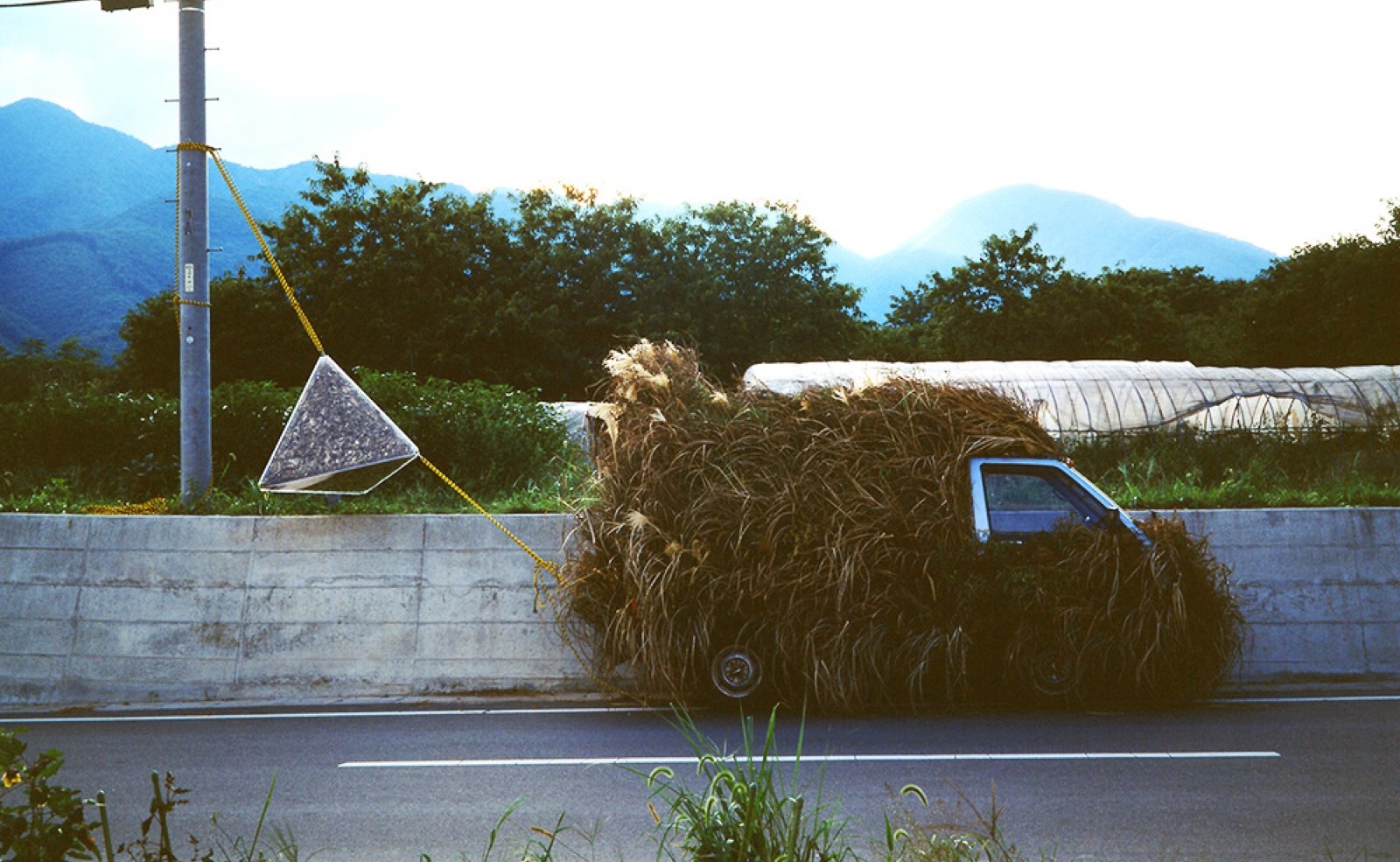
第一回は、白州巡礼と題して、白州の主要道路を車で巡回し、一日おきに場所を変えて5カ所展示した。 草だらけにした車=「自然化された人工物」と、ピカピカに加工された「人工化された自然物オブジェ」をぶつけ合わせた。 逆方向の人工生成物が同居している様は、奇妙で異様に思える。
The first, titled "Hakushu Pilgrimage," went by car around the main roads of Hakushu, changing location every other day to exhibit at five sites. I set a car left thick with grass — an "artificial object made natural" — against a glossily finished "natural object made artificial." The sight of two man-made things running in opposite directions and sharing one place seems strange, uncanny.
聖なるものへの希求が、宗教性、そして死の問題へとつながっていった。
エリザベス.キューブラー.ロス著「死ぬ瞬間」の著作で、死という厳しい現実がありながら、残された生を懸命に良質なものとして充実させる姿勢に、私は感銘を受けた。 そこには「メメント・モリ(死を思え)」があった。 死を思うからこそ生は充実する。 そこに生と死が連結している。 またそれは、他の人々の死が自己を成立させているということでもあるだろう。
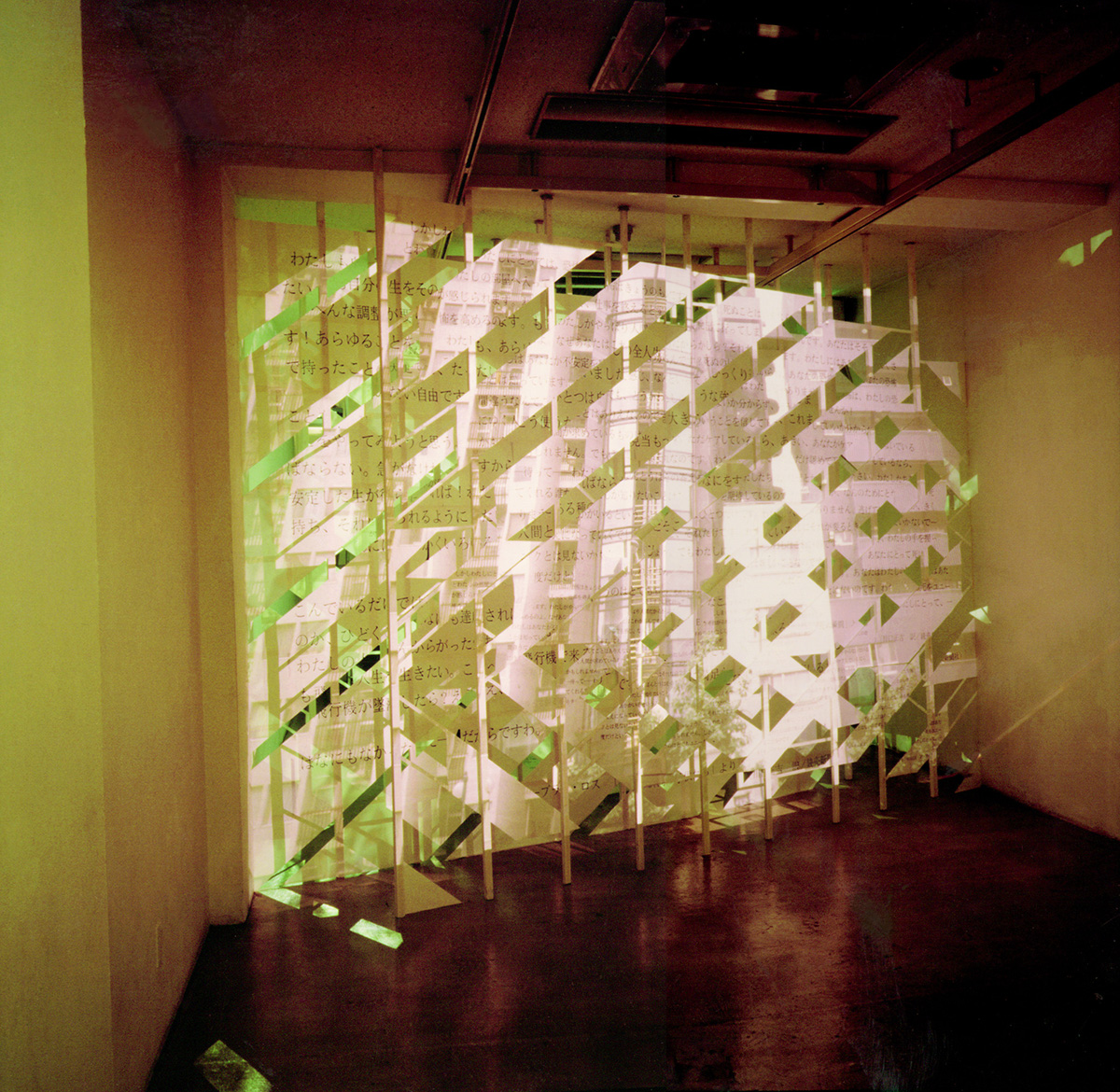
中央を仕切る壁面には、その著書から抜粋したテキストが張り付けられた。
また、自然と人工という括りは、対立しているようでありながら、そうではない。 人自身にも内的には自然が含まれている。 人が生きるために物資を収奪する対象でありながら、恵みや教えをいただくのも、自然である。 壁面の両側から、スライドプロジェクターによって自然を連想させる映像と、人工を連想させる映像が壁面に向けて投影されている。
鑑賞者は、ジグザグに壁面の間を蛇行しながら、両側の空間へと、生と死、人工と自然という観念を行き来する。 単純な建築的インスタレーションだが、今は人そのものをテーマとして空間を作った到達点がある。
NEVERTHELESS(…にもかかわらず)というタイトルは、「自然と人工は対立して見えるにもかかわらず」という言葉の繋がりから生まれた。 対立的に見えるものでも、それを包む関係がある。
My longing for the sacred led on to religiosity, and from there to the question of death.
In Elisabeth Kübler-Ross’s On Death and Dying, I was moved by the attitude of living out what life remains as fully and as well as one can, even in the face of the hard reality of death. A memento mori was there — remember that you must die. It is precisely because one thinks of death that life is filled out. There, life and death are joined. And that must also mean that the deaths of others are what constitute the self.
On the wall dividing the centre of the space, texts excerpted from that book were pasted up.
Again, the categories of the natural and the artificial seem to stand opposed, and yet they do not. The human being, too, contains nature within. Nature is what people plunder for the materials by which they live, and it is also what grants us its blessings and its teachings. From either side of the wall, slide projectors cast images onto it — images that call up nature, and images that call up the artificial.
The viewer, weaving in a zigzag between the walls, moves back and forth into the spaces on either side, and between the ideas of life and death, the artificial and the natural. It is a simple architectural installation, but it stands now as a point of arrival: a space built with the human being itself as its theme.
The title NEVERTHELESS was born out of a joining of words — “even though the natural and the artificial appear to be opposed”. Even in what appears opposed, there is a relation that holds both.
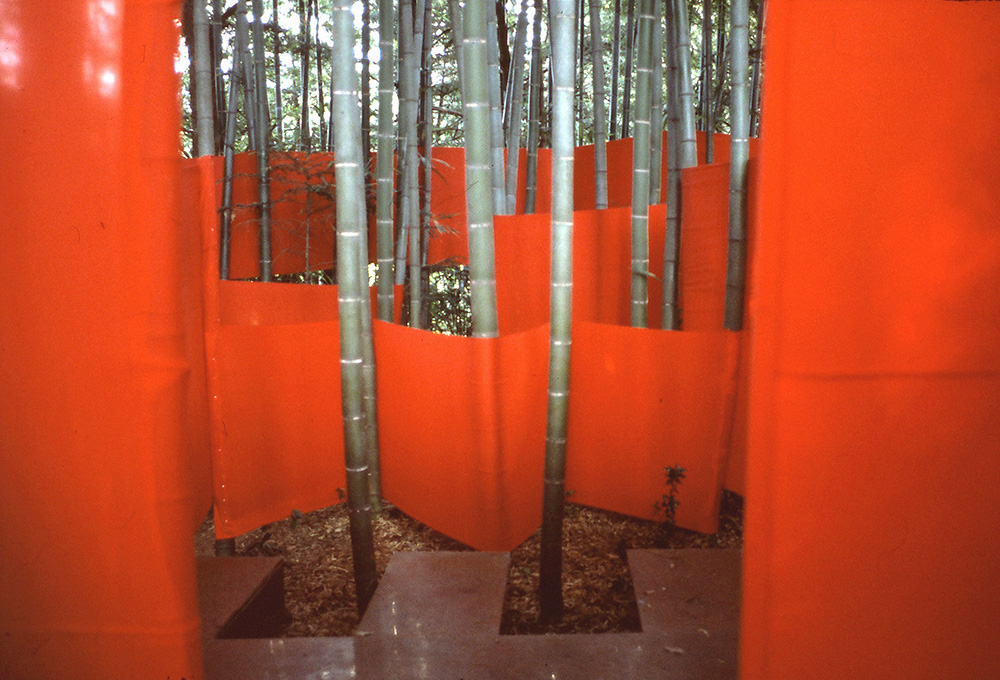
第二回は、ヘンクテルクルヴェ作品を借りて、赤い布を竹林に張り巡らせ、通路、待合、茶飲み場を作り、野点を行った。 赤い布は、緑に対する補色であるため、空間は非日常的なものとなった。 自然と深く関わるための方法を伝統に求めたのだが、伝統的な空間では全くない。 榎倉康二氏、坂口寛敏氏が客人として訪れてくれた記憶は、忘れがたい。 この場で交わされた、人間と自然との関係や、死についての会話によって、深淵が現れたようだった。
For the second, I borrowed a work by Henk Terkulve, strung red cloth all through a bamboo grove, made a path, a waiting area and a place to take tea, and held a nodate — an open-air tea ceremony. Red being the complementary color of green, the space turned into something outside the everyday. I had gone to tradition for a way of engaging deeply with nature, and yet the space was not traditional in the least. The memory of Kōji Enokura and Hirotoshi Sakaguchi coming as guests is hard to forget. In the talk exchanged there about the relationship between human beings and nature, and about death, an abyss seemed to open.
身体気象農場でのコンポスト装置を最終形態として、交渉中だった。 榎倉康二氏が亡くなり、母体となった美術部門「風の又三郎」は解散したため、実現には至らなかった。
これまでに多くのアートイベントを経験したが、白洲フェスティバルの質の高さ、場が放った輝きは、記憶の中でも特異な存在感を放っている。 それぞれ独立した参加者が真摯に、持てる力を最大限発揮し、出会いによって更に質を高めた、稀有な状況だったと思える。 この場を記憶している人は、記録を持ち寄るべきだろう。
A compost apparatus at the Body Weather Farm was to be the final stage, and negotiations were under way. Kōji Enokura died and "Kaze no Matasaburō," the art division that had served as its base, was dissolved, so it never came about.
I have been through many art events, but the quality of the Hakushu Festival, and the brilliance the place gave off, hold a singular presence even among my memories. Each participant stood independent, worked in earnest, drew out every power they had, and raised the quality further through the encounters — a rare situation, it seems to me. Anyone who remembers that place ought to bring their records together.
榎倉康二氏の死去 建築との出会いThe death of Kōji Enokura; an encounter with architecture
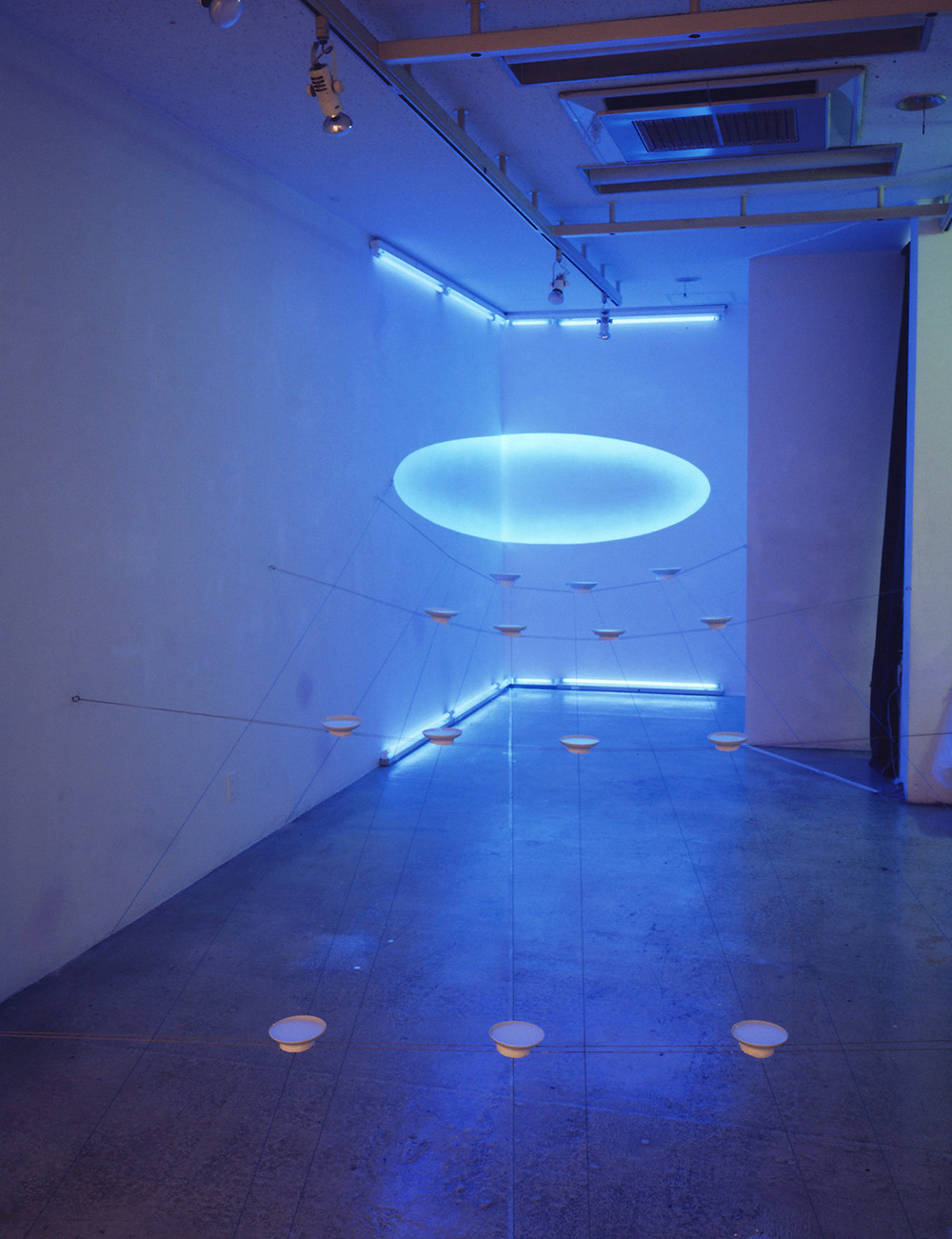
秋山画廊での個展。 階段部には新聞・雑誌テープが巻き付けられ、床にはワイヤーが交差し白い皿に水が湛えられた。 壁面には螺旋階段と同径の楕円が特殊塗料で描かれ、中心軸からしか正確な形として見えない。 恩師・榎倉康二氏の同名展示へのオマージュ展でもあった。
A solo exhibition at Akiyama Gallery. The staircase was wrapped in strips of newspaper and magazine, wires crossed the floor, and white plates held water. On the wall, an oval matching the diameter of the spiral staircase was painted in a special paint, visible in its correct form only from the central axis. The exhibition was also a homage to a show of the same name by my teacher, Kōji Enokura.